Web development · 12 min read
Hiring an Offshore Web Development Agency from the UK, US or Canada: Costs, Contracts and Red Flags
When offshore web development makes sense: time-zone overlap, fixed price vs T&M, code and domain ownership, UK GDPR transfers and red flags.
On this page
- When does hiring offshore make sense, and when does it not?
- How much time-zone overlap do you get with India?
- How should you scope the project before asking for quotes?
- Fixed price or time and materials?
- What drives the cost of an offshore web project?
- How should milestone payments work?
- Who owns the code, and what should the contract say?
- Who should own the domain, hosting and accounts?
- What about data protection if the agency handles personal data?
- How often should you hear from the agency?
- What are the red flags when hiring an offshore agency?
- How do you check an agency's portfolio properly?
- A step-by-step hiring process
- Frequently asked questions
- About the author
Hiring an offshore web development agency works when the scope is written down, the code, domain and hosting sit in your own accounts from day one, and you pay against milestones you can see working on a staging site. It goes wrong when the brief is vague, nobody's working day overlaps with yours, or the agency keeps everything in its own accounts. Those controls matter more than the hourly rate.
This guide is for founders and SME owners in the UK, the US and Canada who are weighing up an agency in India or elsewhere. Digital Architect is itself an Indian agency, so read it with that in mind. Every check below applies to us as much as to anyone else.
When does hiring offshore make sense, and when does it not?
Offshore works well when the work can be described in writing and checked by someone on your side. It works badly when the project depends on daily, in-person judgement calls.
It tends to make sense when:
- the scope is reasonably clear, such as a marketing site, a web app with defined user roles or a rebuild;
- someone on your side can make decisions and review work every week;
- you are comfortable working asynchronously, with written updates and recorded demos.
It tends not to make sense when:
- the idea is still forming and nobody on your side can act as product owner;
- the work needs regular on-site presence, such as hardware integration or staff workshops;
- a regulator or your own clients require suppliers in a particular country.
How much time-zone overlap do you get with India?
India Standard Time is UTC+5:30, and India does not change its clocks. The gap with you therefore shifts whenever your clocks change. UK clocks change on the last Sunday in March and October: 29 March and 25 October in 2026 (GOV.UK, accessed Oct 2026). US clocks change on the second Sunday in March and the first Sunday in November: 8 March and 1 November in 2026. Arizona and Hawaii do not change (NIST, accessed Oct 2026). Ontario uses the same dates as the US (National Research Council Canada). British Columbia stopped changing its clocks in 2026 and will not fall back on 1 November (BC Government, 17 Sep 2026).
Here is what 9:00 your time is in India:
- UK on GMT (late October to late March): IST is 5h30 ahead, so 9:00 is 14:30 IST.
- UK on BST (late March to late October): 4h30 ahead, so 13:30 IST.
- US and Canadian Eastern, on EST: 10h30 ahead, so 19:30 IST.
- Eastern, on EDT: 9h30 ahead, so 18:30 IST.
- US Pacific, on PST: 13h30 ahead, so 22:30 IST.
- US Pacific on PDT, and British Columbia all year (UTC−7): 12h30 ahead, so 21:30 IST.
In practice, a UK client on a 9:00 start shares four and a half to five and a half hours with a team working 10:00–19:00 IST, which is plenty. East-coast clients usually get a short shared window early in their morning, with the agency working into its evening. West-coast clients do better with a handover model: feedback goes over at the end of your day, the work happens overnight, and you review it the next morning. Ask any agency who on their side works the overlap and how often.
How should you scope the project before asking for quotes?
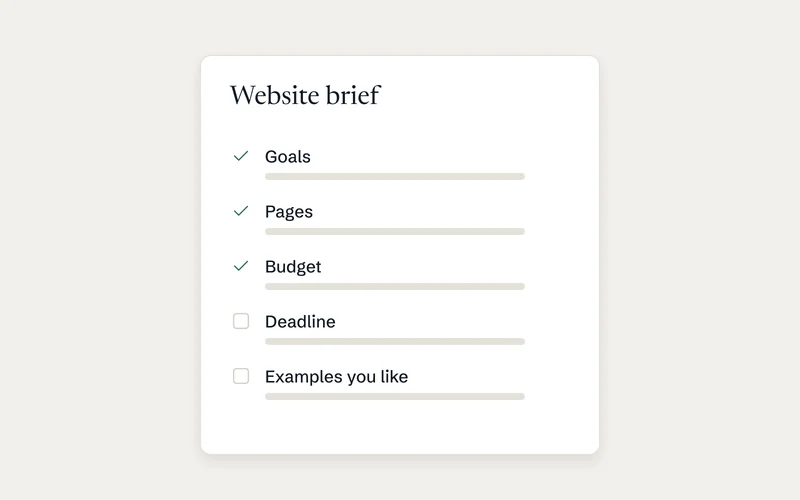
Write a brief that two agencies would read the same way. Include:
- The goal: what the site or app must achieve, and how you will measure it.
- Users and roles: who logs in, what each type of user can do, and who administers it.
- Pages or features, ranked as must-have, should-have and later.
- Integrations: payments, CRM, booking, accounting, email and any APIs, with the provider named.
- Content: who writes it, who supplies the images, and how much has to be migrated.
- Non-functional needs: accessibility, devices, expected traffic and hosting region.
- What is out of scope. This line prevents more disputes than any other.
A good agency will push back on the brief and ask questions before quoting. Be wary of one that quotes within an hour without asking anything. At Digital Architect, a written plan and price come before any work starts, and any supplier should be able to give you the same.
Fixed price or time and materials?
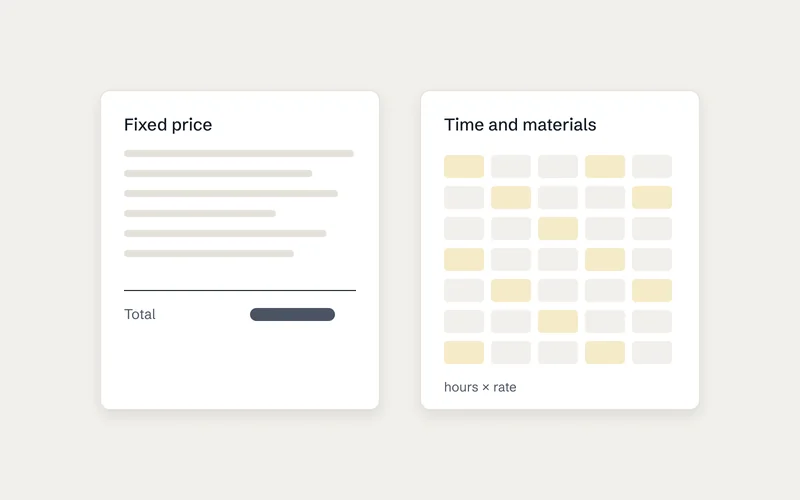
Choose fixed price when the scope is stable, and time and materials when you expect to learn and change course as you build.
- Fixed price gives you a known cost for a defined scope. The agency carries the risk of overrun, so expect the quote to include a margin for that risk, and expect changes to go through a change-request process. It suits brochure sites, rebuilds and well-specified first versions.
- Time and materials means you pay for the hours actually worked, at agreed rates. It suits products that will change after users try them. It only works with weekly timesheets, a shared task board and a monthly cap you have to approve before it is exceeded.
- A hybrid often works best for new products: a fixed-price discovery phase that produces a specification and an estimate, then time and materials or fixed-price phases for the build.
What drives the cost of an offshore web project?
Rates vary widely by country, city, seniority and type of firm, so compare like with like. The total depends more on scope than on the hourly rate: the number of features and user roles, integrations (especially with poorly documented systems), custom design versus an adapted theme, content and data migration, the seniority mix, testing and security work, compliance needs such as audit trails, a compressed timeline, and support after launch.
Ask every bidder to break the quote down by phase and feature. Two quotes that differ by a factor of three usually describe two different projects.
How should milestone payments work?
Tie each payment to something you can see working, not to time passing. A typical pattern is a deposit to start, then payments on approved designs, on a working build on staging, and on launch, with a final portion held back for a short warranty period after go-live.
Make three conditions part of every milestone:
- The work is on a staging site you can use, not just shown in a screen-share.
- The code is in a repository you own, with commits up to that milestone.
- There is a fixed acceptance window, such as five working days, with a written list of defects if you reject the work.
Avoid paying most of the fee upfront, and avoid a final payment that is due before you can test the finished product.
Who owns the code, and what should the contract say?
The contract should include an express written assignment to you of copyright in everything created for the project, effective on payment. Without one, you may not own what you paid for.
- UK. When you commission work, the first owner of copyright is the person or organisation that created it, "unless you otherwise agree it in writing" (Intellectual Property Office, accessed Oct 2026). An assignment is "not effective unless it is in writing signed by or on behalf of the assignor" (CDPA 1988, s.90(3)).
- US. Commissioned work counts as "work made for hire" only if it falls within nine listed categories and both parties sign a written agreement saying so (U.S. Copyright Office, Circular 30). Custom software does not always fit those categories, so contracts usually add an express assignment as a backstop.
- Canada. An assignment of copyright must be in writing, signed by the owner or the owner's agent (Copyright Act, s.13(4)).
- If the agency is in India. Under India's Copyright Act 1957, if an assignment does not state its duration it is deemed to be five years, and if it does not state its territory it is presumed to extend only within India (s.19(5) and (6), text via Indian Kanoon). Make sure the assignment says "worldwide" and "for the full term of copyright".
Also ask for a list of the third-party and open-source components used, with their licences. Any pre-existing agency code, such as a framework they reuse, should come with a perpetual, royalty-free licence for you to use and modify. Finally, the contract should name the governing law and say where disputes will be heard.
Who should own the domain, hosting and accounts?
You should. Open every account in your company's name, with you as the owner or admin, and add the agency as a user. ICANN describes letting a hosting provider, web developer or law firm be listed as a domain's registrant as "generally not considered a good practice" (ICANN, 23 Jun 2017).
The list to check:
- domain registrar and DNS;
- hosting or cloud account, and the billing account behind it;
- the code repository;
- app store developer accounts, if there is an app;
- Google Analytics, Search Console, Google Business Profile and ad accounts;
- email sending, payments, maps and any other paid APIs;
- the CMS admin login.
This is how we work with clients at Digital Architect: ad, analytics and tracking accounts are created in the client's name, with the client as admin. When the engagement ends, you remove the agency's access and nothing has to be transferred.
See also: Full-stack development
What about data protection if the agency handles personal data?
If the agency can access your customers' personal data, for example in a production database, through support logins or in form submissions, it is acting as your data processor, and the law of your country follows the data. This is general information, not legal advice.
- UK. You need a written controller–processor contract that covers the terms in Article 28 of the UK GDPR: acting only on your documented instructions, confidentiality, security, use of sub-processors, help with individuals' rights, deletion or return of data at the end, and audits (ICO, accessed Oct 2026). Giving a supplier outside the UK access to the data is a restricted transfer, and India is not covered by UK adequacy regulations (ICO list, accessed Oct 2026). The usual route is the ICO's International Data Transfer Agreement (IDTA), or the Addendum to the EU standard contractual clauses, plus a transfer risk assessment. The ICO plans to update both in 2026 to reflect the Data (Use and Access) Act, and says to keep using the current versions until then (ICO, accessed Oct 2026).
- US. If your business is covered by the CCPA, your contract with a service provider must, among other things, prohibit it from selling or sharing the data and limit its use to the business purposes the contract names (CCPA regulations, s.7051).
- Canada. Under PIPEDA you stay accountable for information you transfer to a processor. The main tool is a contract, and you should tell customers, in plain language, that their information may be processed in another country (Office of the Privacy Commissioner of Canada, accessed Oct 2026).
The simplest protection is to give developers anonymised or synthetic test data, and to limit production access to named people who need it.
How often should you hear from the agency?
Agree the rhythm in writing before work starts:
- Weekly: a short written update covering what was done, what is next and what is blocked, plus a call in the overlap window.
- Every sprint: a demo on staging. We run two-week build cycles, so clients see working software every fortnight.
- Always: a shared task board you can read, one named project lead, and response times for normal questions and for outages.
What are the red flags when hiring an offshore agency?
- No access to the code until the final payment, or no repository at all.
- No staging site, so progress only appears in screenshots and calls.
- Everything in the agency's accounts: the domain, hosting, analytics and app store listings.
- Vague estimates, such as a single number with no breakdown by feature, or "it depends" with no range.
- No references, or references who won't take a call.
- A portfolio of screenshots only, with no live URLs.
- Changing faces: the people on the sales call never appear again, and nobody can tell you who will actually write the code.
- Reluctance to sign an IP assignment or a data processing agreement.
How do you check an agency's portfolio properly?
Ask for live URLs, then check them yourself.
- Open each site on your phone and laptop. Try the forms, the navigation and the checkout, if there is one.
- Run the main pages through PageSpeed Insights. A portfolio piece that fails Core Web Vitals tells you something.
- Ask exactly what the agency did. Design, build, hosting, marketing, or only one of them?
- Speak to two recent clients, ideally in your country, and ask how missed deadlines and problems were handled.
For example, our UK reference is Build Hive, a construction SaaS platform for UK builders, live at build-hive.co.uk, with a case study that sets out what we built. Hold every agency, us included, to the same test. The rest of our work is on our case studies page.
A step-by-step hiring process
- Write the brief, including what is out of scope.
- Shortlist three to five agencies with live work similar to yours.
- Hold a call with each, and judge the quality of their questions.
- Ask for a written proposal with a phased breakdown, named team members and a sample contract.
- Check live URLs and speak to two references.
- Agree the contract: IP assignment, account ownership, milestones, acceptance, data protection and cadence.
- Start with a paid discovery phase or a small first milestone.
Frequently asked questions
Is it safe to hire a web development agency in India?
It can be, if the contract assigns the IP to you, the accounts are in your name and payments follow working milestones. Those controls protect you with any supplier.
Who owns the code if the contract says nothing?
In the UK, copyright in commissioned work belongs to whoever created it unless you agree otherwise in writing, and you may get only a limited licence. US and Canadian law also require a signed, written assignment, so get one in every case.
Do I need an IDTA to work with an Indian agency?
Only if the agency will access personal data covered by the UK GDPR. If developers work only with anonymised test data, you may not be making a restricted transfer at all.
Should I choose fixed price or time and materials for an MVP?
A fixed-price discovery phase followed by time and materials, with a monthly cap, suits most MVPs, because the scope changes once users try the product.
How much time-zone overlap is enough?
Two to three hours a day is usually enough for a call and quick questions. UK clients usually get more than that with India, while US clients often rely on a daily handover instead.
Should I pay an agency upfront?
Pay a modest deposit to start, then pay against milestones you can test on staging, with code in your repository. Hold back a final portion until after launch.
About the author
Arjun Raj is the founder of Digital Architect, a web, app and digital marketing studio founded in 2023. It is headquartered in LB Nagar, Hyderabad, with a studio in Bengaluru, and delivers for clients across India, the United States, Canada and the United Kingdom. Arjun holds a B.Tech in Computer Science and Engineering, specialising in cybersecurity, from IIT Guwahati. More about Arjun
Weighing up an offshore agency? Send us your brief, and we will tell you plainly whether we are a good fit. See how we work or talk to Digital Architect.