Web development · 12 min read
How Much Does It Cost to Build a Website or App in the UK, US and Canada in 2026?
What drives website and app costs in the UK, US and Canada, the fees people forget, and how to brief agencies so their quotes can be compared.
On this page
- Why doesn't this guide quote an average price?
- What drives the cost of a website or app?
- What do developers earn in the UK, US and Canada?
- How do you estimate the cost before asking for quotes?
- What are the typical cost bands?
- What fees and running costs do people forget?
- What does accessibility law require?
- Onshore or offshore: what are the real trade-offs?
- How do you brief agencies so their quotes can be compared?
- Frequently asked questions
- About the author
The cost of a website or app is the effort your scope needs, multiplied by the rate of the people doing the work, plus fees and running costs that continue after launch. Features, design depth, integrations, platforms and compliance drive the effort; location and seniority drive the rate. Estimate from a written feature list, not from an "average cost" headline.
This guide is for founders and SME owners in the UK, US and Canada who are budgeting for a new website, a rebuild or a first app.
Why doesn't this guide quote an average price?
Most "average website cost" figures come from agency marketing pages or directory surveys. They tend to have small samples, unclear definitions of what was built, and an interest in the answer. Two projects both called "a website" can differ enormously in effort.
So this guide does three things instead. It explains what moves the cost, cites official wage data you can use to sanity-check a day rate, and gives you a method to estimate your own project. Where a fee is fixed and published, such as an app store account, it gives the exact figure.
What drives the cost of a website or app?
Eight factors account for most of the difference between quotes.
- Scope and number of features. Every feature needs design, build, testing and maintenance. User accounts, payments, search, booking, notifications and admin dashboards each add real work. A five-page brochure site and a customer portal are different projects.
- Design depth. Adapting a theme is quick. Custom design with research, wireframes, a design system and prototypes takes longer, and is worth it when the interface is the product.
- Integrations. Connecting to a CRM, accounting package, booking system, payment provider or an older internal system is often the least predictable item. The other system's documentation and data quality decide how long it takes.
- Platforms. A website, an iOS app and an Android app are three things to build, test and maintain. A cross-platform build shares most code between iOS and Android; native Swift and Kotlin builds cost more and give the most polished result. Either way you still need two store accounts, device testing and two review processes.
- CMS or custom. A content-managed site built on an established CMS suits marketing sites. Custom code suits products with their own logic, such as a booking engine or a SaaS platform. Many projects need both: a CMS for marketing pages and a custom application behind a login.
- Compliance. Accessibility, data protection, sector rules (health, finance, legal) and security reviews add design, build and testing time. They cost far less when planned in from the start.
- Hosting and maintenance. Servers, backups, monitoring, security patches and platform updates continue every month after launch.
- Store fees and commissions. App stores charge account fees, and take a commission on some types of in-app sales (covered below).
What do developers earn in the UK, US and Canada?
Official wage data shows the starting point for any rate. These are employee wages, not agency prices:
- UK: the median gross hourly pay for full-time programmers and software development professionals was £31.25 in April 2026, or £59,863 a year (ONS ASHE Table 14, 2026 provisional, released 22 Oct 2026).
- US: the median pay for web developers and digital designers was $47.85 an hour in May 2025 (US Bureau of Labor Statistics, accessed Oct 2026). Software developers had a median annual wage of $135,980 (BLS, accessed Oct 2026).
- Canada: the median wage for web developers (NOC 21234) was C$38.46 an hour nationally and C$40.00 in Ontario, for 2023–2024 (Job Bank, updated Nov 2025).
Agency and freelance rates sit above these figures. They also have to cover employer costs, holidays, unbilled time, project management, design, testing, tools and profit. Use the wage data to judge whether a quoted day rate is plausible for the location and seniority claimed, not as a price.
How do you estimate the cost before asking for quotes?
Work from features to effort to money. This takes an afternoon and makes every later conversation shorter.
- List your users and what each must do. For example: "a customer books a repair slot and pays a deposit"; "a technician sees today's jobs on a phone"; "the office reassigns a job".
- Turn that into a feature list, and mark each feature as needed for launch or later. Keep the launch list short.
- Name every integration and the system on the other side, such as Stripe, Xero, HubSpot or a legacy database.
- Choose platforms. Decide whether you need a responsive website, a web app, iOS, Android or a combination, and justify each one.
- Decide CMS or custom for each part, and who will edit content after launch.
- Get effort as a range for each feature (low and high, in days) from a developer you trust, or from the quotes themselves. Add design, testing, project management and launch work as separate lines.
- Multiply by a blended day rate, then add a contingency line. Ask each agency what contingency it assumes and why.
- Add year-one running costs: domain, hosting, email, store accounts, maintenance and any paid services, such as maps, SMS or email delivery.
The result is a range, not a number. Its value is that you know which features make the range wide. Those are the ones to question, simplify or move to a later phase.
What are the typical cost bands?
Without reliable market data, it is more honest to describe the bands by what drives them than to attach prices.
- Template or theme site. A handful of pages, a contact form and a hosted builder or CMS theme. Low effort; the main costs are content and photography.
- Custom-designed CMS site. Bespoke design, a structured content model, SEO set-up and one or two integrations, such as booking or a CRM. Moderate effort, driven mostly by design and content.
- E-commerce site or web app. User accounts, payments, an admin panel and business logic. Substantially more effort, driven by the feature count and integrations.
- Mobile app with a backend. One or two apps, a server and API, an admin panel, push notifications and store releases. Usually the largest band, because several pieces must be built and then maintained together.
See also: Website development · Mobile app development
What fees and running costs do people forget?
These are small next to the build, but they recur every year.
- Domain. An annual renewal. A .ca domain requires the registrant to meet CIRA's Canadian Presence Requirements (CIRA, accessed Oct 2026). That is one more reason to register it in your own company's name, not your agency's.
- Hosting. A monthly or annual fee, or usage-based billing on cloud platforms. Ask what happens to the bill if traffic grows tenfold.
- SSL certificates. Free certificates are widely available, but maximum certificate lifetimes are being cut in stages from 398 days to 47 days between March 2026 and March 2029 (CA/Browser Forum, Apr 2025). Renewal must be automated, or it becomes a recurring task someone is paid to do.
- Email. Usually a per-user monthly subscription. Apple's new Apple Business platform offers free email on your own domain (Apple, accessed Oct 2026), so compare options before committing.
- Apple developer account. The Apple Developer Program is US$99 per membership year, and organisations (other than government entities) need a D-U-N-S number to enrol (Apple Developer, accessed Oct 2026).
- Google Play developer account. A US$25 one-time fee (Play Console Help, accessed Oct 2026). New personal accounts must also run a closed test with at least 12 testers for 14 consecutive days before they can publish (Play Console Help, accessed Oct 2026). Build that time into the launch plan.
- Store commissions. If your app sells physical goods or services used outside the app, such as a repair visit or a delivery, Apple requires you to use a method other than in-app purchase, such as Apple Pay or card entry (App Review Guidelines 3.1.3(e), accessed Oct 2026). Google's payments policy is similar (Play Console Help, accessed Oct 2026). Digital goods and subscriptions are different: Apple charges 15% under its Small Business Program for developers with up to US$1 million in proceeds (Apple Developer, accessed Oct 2026). Google is introducing new, region-specific fees in 2026, in the US from 30 June (Play Console Help, accessed Oct 2026). Check the current schedule for your market.
- Platform updates. From 31 August 2026, new Android apps and updates must target Android 16 (API level 36) (Play Console Help, accessed Oct 2026). The requirement moves forward each year, so an app needs paid upkeep even when you add no features.
- Maintenance. CMS and plugin updates, dependency security patches, backups and small fixes. Ask for this as a separate monthly line in every quote.
- Analytics. Google Analytics 4 is free to use. The cost is the time to define conversions, set them up and test them, plus a consent banner where the law requires one.
What does accessibility law require?
This is a short summary. The rules differ by country, and in the US by type of organisation.
- UK: public sector bodies must meet WCAG 2.2 AA and publish an accessibility statement. GOV.UK says they remain "legally responsible" even if the website is outsourced to a supplier (GOV.UK, updated 30 Sep 2024).
- US: the Department of Justice's position is that the ADA covers the goods and services businesses offer on the web. It has no detailed technical regulation for businesses, and points to WCAG as helpful guidance (ADA.gov, 18 Mar 2022). State and local governments have a specific rule (WCAG 2.1 AA), with compliance dates extended in April 2026 to 26 April 2027 and 26 April 2028, depending on population (Federal Register, 20 Apr 2026).
- Ontario: under the AODA, designated public sector organisations, and businesses and non-profits with 50 or more employees, must meet WCAG 2.0 AA on public websites, with two exceptions (live captions and pre-recorded audio description). This has applied since 1 January 2021 (Ontario.ca, updated Sep 2026).
Whatever the law requires of you, write the target (for example "WCAG 2.2 AA") into the brief. Building accessibility in costs less than auditing and retrofitting it later.
This is general information, not legal advice.
Onshore or offshore: what are the real trade-offs?
Digital Architect is a studio in India that builds for clients in the US, Canada and the UK, so we sit on the offshore side of this comparison. Here are the trade-offs as we see them.
- Rate. Lower day rates are the main reason buyers look offshore. Compare the total for the same itemised scope, not the day rate alone, because a cheaper team that needs more days or more of your time can cost the same in the end.
- Time zones. India is 4½ hours ahead of the UK in summer and 5½ in winter. It is 9½ to 10½ hours ahead of US Eastern time. UK projects get a comfortable daily overlap. North American projects need a fixed call slot and good written handovers.
- Specification discipline. Distance punishes vague briefs. Offshore work goes well when scope, acceptance criteria and priorities are written down, which also helps onshore projects.
- Local knowledge. An onshore team may already know the AODA, a US state's licensing rules or local payment habits. An offshore team must be briefed on them, or must prove it already knows them.
- Contracts and data. Agree which country's law governs the contract and who owns the code. If the supplier will handle personal data, UK GDPR requires a written processor contract (ICO, accessed Oct 2026). In Canada, under PIPEDA, you remain accountable for personal information you transfer to a provider for processing (Office of the Privacy Commissioner of Canada, accessed Oct 2026).
- Ownership of accounts. Whoever you hire, the domain, hosting, code repository, analytics and store accounts should be created in your company's name, with the agency added as a user. We set up client projects this way, and it means you can change suppliers without losing anything.
For an example of offshore work for a UK market, see our Build Hive case study, a construction SaaS platform for UK builders.
How do you brief agencies so their quotes can be compared?
Send every agency the same brief and ask for the same answer format. Otherwise you are comparing three different projects.
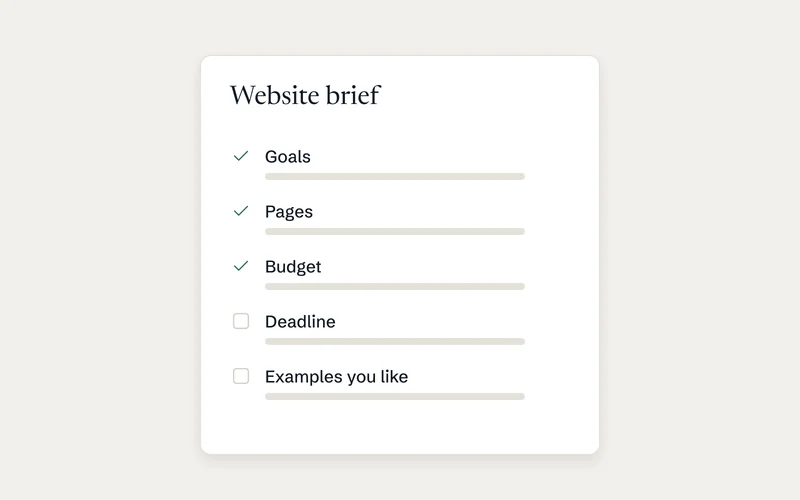
Put this in the brief:
- The business goal and the number that defines success, such as booked jobs, sign-ups or online sales.
- The users and the tasks each must complete.
- The feature list, marked "launch" or "later".
- Every integration, with the product name and whether an API exists.
- Platforms, plus the browsers and devices you must support.
- Who edits content after launch, and what they need to change.
- Design expectations, with two or three reference sites or apps and what you like about each.
- Compliance needs: accessibility target, data location, and sector rules.
- Fixed dates, and a budget range. Sharing a range saves everyone from proposals that are wildly over or under it.
Ask every agency to return:
- an itemised estimate by feature or phase, with effort shown;
- the team, their roles and the day rate;
- assumptions and exclusions, in writing;
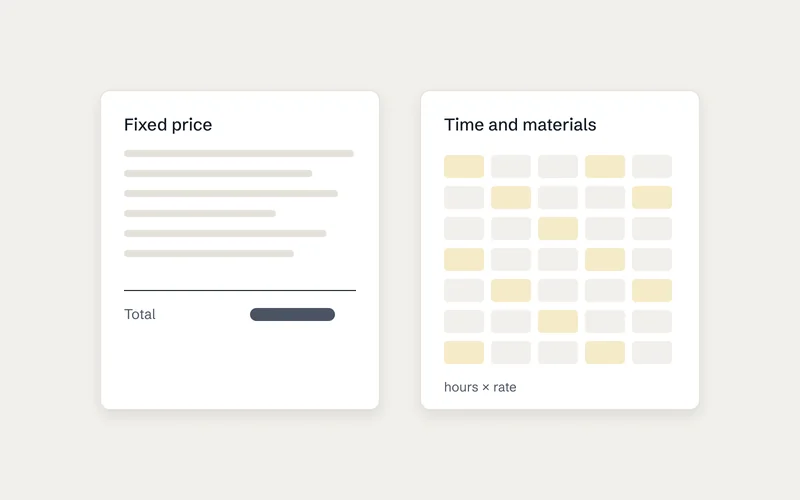
- whether the price is fixed or time-and-materials, and how change requests are priced;
- payment milestones tied to deliverables;
- the warranty period, and the monthly maintenance price as a separate line;
- confirmation that code and accounts belong to you.
Then lay the answers side by side, line by line. Large gaps usually come from different assumptions, not different skill, so ask about those first.
Frequently asked questions
How much does a small business website cost in the UK, US or Canada?
It depends on scope and on who builds it. A theme-based site with a few pages sits at the low end; custom design, integrations and e-commerce move it up. Get three itemised quotes against the same brief.
Is it cheaper to build one app for iOS and Android?
Often, yes. Cross-platform frameworks share most code between the two. You still pay for two store accounts, testing on both platforms and two review processes.
How much does it cost to publish an app?
Apple charges US$99 a year for the Apple Developer Program. Google Play charges a one-time US$25 registration fee.
Do Apple and Google take a cut if my app sells services like cleaning or repairs?
Not through in-app purchase. Physical goods and services used outside the app must be paid for through other methods, such as card payments, which carry their own processing fees.
Should the agency or my company own the domain and app store accounts?
Your company should. Register everything in your own name, and add the agency as a user.
How much should I budget for maintenance?
Ask every agency to price it as a monthly line, with a stated scope: updates, security patches, backups, monitoring and a number of support hours. Apps also need annual platform updates.
About the author
Arjun Raj is the founder of Digital Architect, a development and digital marketing studio headquartered in LB Nagar, Hyderabad, with a studio in Bengaluru. Since 2023 it has built websites, web apps and mobile apps for clients across India, the US, Canada and the UK. Arjun holds a B.Tech in Computer Science and Engineering, specialising in cybersecurity, from IIT Guwahati. More about Arjun
Budgeting a website or app? Send us your feature list, even a rough one. We will reply with a written plan and price before any work starts. Talk to Digital Architect.