SEO & answer engines · 12 min read
AEO vs SEO vs GEO: How to Get Found in Google, AI Overviews and ChatGPT in 2026
What SEO, AEO and GEO mean in 2026, what really changes, and how to structure pages so Google AI Overviews, ChatGPT and Copilot can quote them.
On this page
- What do SEO, AEO and GEO actually mean?
- What changes when an AI answers the question?
- How do you structure a page so answer engines quote it?
- Do FAQs and schema markup still help?
- Why do entity consistency and author bylines matter?
- Why does Bing matter in 2026?
- Which AI crawlers should you allow?
- What is llms.txt, and do you need one?
- How do you measure AI referrals in GA4?
- A first-30/60/90-days plan
- Frequently asked questions
- About the author
SEO gets your pages crawled, indexed and ranked in search engines. AEO (answer engine optimisation) and GEO (generative engine optimisation) are newer labels for making those same pages easy for AI answers, such as Google's AI Overviews, ChatGPT search, Microsoft Copilot and Perplexity, to find, understand and cite. In practice they are one discipline: indexable pages that answer questions directly, consistent facts about your business everywhere it appears, the right crawlers allowed, and measurement that separates AI referrals from ordinary search.
This guide is for business owners and marketers in the UK, the US and Canada who want a plain answer on what to change, and what to leave alone.
What do SEO, AEO and GEO actually mean?
They describe the same goal from three angles. None has an official definition; they are industry terms, used loosely.
- SEO (search engine optimisation) gets pages crawled, indexed and ranked: technical health, useful content, links and local listings.
- AEO (answer engine optimisation) aims to be the source an engine quotes when it answers a question directly, as with featured snippets and voice assistants, and now AI answers.
- GEO (generative engine optimisation) aims to be cited, and described accurately, in answers written by large language models such as ChatGPT, Copilot, Perplexity, Gemini and Google's AI Mode.
Google's position is blunt. Its guide to generative AI features says that "optimizing for generative AI search is optimizing for the search experience, and thus still SEO" (Google Search Central, updated Jul 2026). The same guide asks site owners to judge third-party AEO and GEO services against its general guidance on hiring SEO help.
What changes when an AI answers the question?
Fewer people click, and the clicks that do come arrive from a shortlist of cited sources rather than from ten blue links. What does not change is how pages get into that shortlist.
What changes:
- Clicks fall when a summary appears. In a Pew Research Center study of 900 US adults' browsing in March 2025, users who saw an AI summary clicked a traditional result in 8% of visits, against 15% when no summary appeared. Only 1% of visits involved a click on a link inside the summary (Pew Research Center, 22 Jul 2025). That was one month of US data. Treat it as a direction of travel, not a forecast for your site.
- One question becomes several searches. Google says AI Overviews and AI Mode may use "query fan-out", issuing multiple related searches across subtopics to build an answer (Google Search Central, accessed Oct 2026). A page that answers a sub-question clearly can be cited even if it would not rank first for the main query.
What stays the same:
- Indexing comes first. To appear as a supporting link in AI Overviews or AI Mode, "a page must be indexed and eligible to be shown in Google Search with a snippet". Google adds that "there are no additional technical requirements" (Google Search Central).
- Quality systems still decide. Google says its generative AI features rely on its core ranking and quality systems. Since May 2026 it has stated that its spam policies apply to generative AI responses too.
See also: SEO and link building
How do you structure a page so answer engines quote it?
Put a direct answer to the page's main question in the first two or three sentences, then use question-shaped headings, each followed by its own short answer and supporting detail. Write from first-hand experience that other pages cannot copy.
- Answer first. If the page is "How long does a kitchen remodel take?", the opening paragraph gives the typical range and what drives it. The detail comes underneath. An answer engine lifting one paragraph should get a complete, correct statement.
- Question headings. Use the questions customers actually ask: "Do I need a permit to replace a deck in Ontario?" or "Is a loft conversion permitted development?" Each heading should be followed by a one or two-sentence answer.
- Lists and tables for comparisons, steps and specifications. Bing's own guidance for being cited in AI answers recommends clear headings, tables and FAQs, and supporting claims with evidence (Bing Webmaster Blog, 10 Feb 2026).
- Non-commodity content. Google's guide stresses this above all: provide "a unique point of view" and "don't just recycle what others on the internet have already said" (Google Search Central). Your own prices, timelines, photos, data and worked examples are what an AI answer cannot get elsewhere.
- No need to "chunk". Google states there is "no requirement to break your content into tiny pieces for AI to better understand it". Write at whatever length the reader needs.
One caution: do not mass-produce near-identical pages for every question variant or city. Google's guide classes that as scaled content abuse, and it understands synonyms well enough that you do not need a page per phrasing.
See also: Content marketing
Do FAQs and schema markup still help?
Yes, for readers and for clarity, but not because they trigger a special AI feature. Google stopped showing FAQ rich results in Search on 7 May 2026 and removed the documentation in June (Google Search Central updates, accessed Oct 2026). Google also says there is "no special schema.org structured data" needed to appear in AI Overviews or AI Mode.
What that means in practice:
- Keep FAQ sections on the page where customers genuinely ask those questions. They answer sub-questions cleanly, and Bing names FAQs among the formats that help its AI answers reference content. Just do not expect FAQ markup to produce a rich result in Google any more.
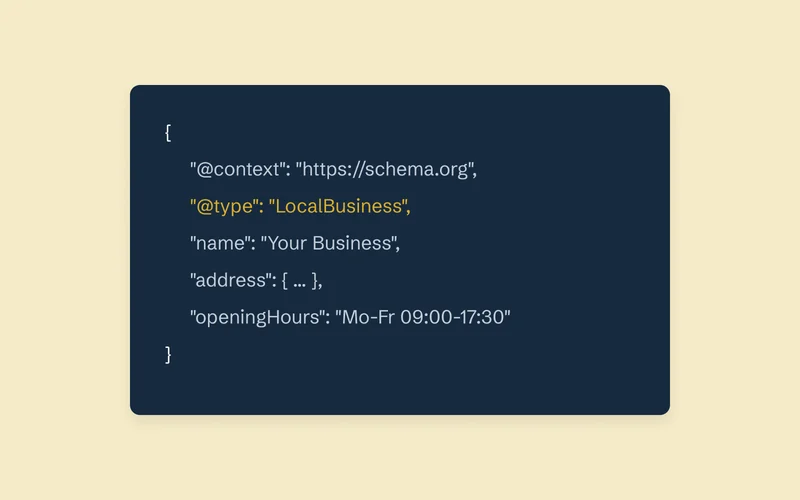
- Keep structured data that still drives rich results or describes your business: Organization, LocalBusiness, Product, Review snippets and Article, where they apply. Google's AI guide recommends continuing to use structured data as part of an overall SEO strategy.
- Mark up only what is visible on the page. Markup that contradicts the page does more harm than having none.
Why do entity consistency and author bylines matter?
AI answers describe businesses by stitching together what they find across the web. If your name, address, services and people are described differently on your site, your Google Business Profile, LinkedIn and directories, the answer can be wrong or can leave you out.
Entity consistency:
- Use one business name, one address format and one phone number everywhere.
- Add Organization structured data to your home page or about page, with
sameAslinks to your official profiles. Google says this helps it "disambiguate your organization in search results" (Google Search Central, accessed Oct 2026). - For local businesses, keep your Google Business Profile complete. Google's AI guide says Business Profiles and Merchant Center "can help your products and services to be visible in both AI responses and other Google Search results".
- Bing's guidance adds that text, images and video should be consistent about the same entities.
Author bylines:
Google "strongly encourage[s] adding accurate authorship information, such as bylines to content where readers might expect it", ideally linking to more about the author. Of experience, expertise, authoritativeness and trust, it says "trust is most important" (Google Search Central, updated 5 Oct 2026). A named author with a real bio page, credentials and a consistent presence elsewhere is easier for any system to trust than "Admin".
Why does Bing matter in 2026?
Bing's index sits behind Microsoft Copilot and Bing's own AI summaries, and Microsoft announced Bing as ChatGPT's default search experience in 2023. Plenty of businesses that do well in Google have never verified their site in Bing Webmaster Tools.
- Copilot and Bing summaries. Bing's AI Performance report, launched in public preview in February 2026, shows how often your pages are cited in "Microsoft Copilot, AI-generated summaries in Bing, and select partner integrations". It covers total citations, cited pages and the "grounding queries" the AI used. Bing notes the grounding query data is a sample (Bing Webmaster Blog, 10 Feb 2026). In June 2026 Bing added Intents, Topics, Citation Share and Compare views in preview (Bing Search Blog, Jun 2026).
- ChatGPT. In 2023 Microsoft announced it was "bringing Bing to ChatGPT as the default search experience" (Bing Blog, May 2023). OpenAI also runs its own search crawler, OAI-SearchBot, and says sites that block it will not be shown in ChatGPT search answers (OpenAI, accessed Oct 2026). Being well indexed in Bing helps, but it is not the whole picture for ChatGPT.
- Freshness. Bing recommends IndexNow, which notifies participating search engines when a URL is added, updated or removed, so that AI answers reference the current version of a page.
The practical steps: verify your site in Bing Webmaster Tools, submit your sitemap, turn on IndexNow if your CMS or host supports it, and check the AI Performance report monthly.
Which AI crawlers should you allow?
Allow the search crawlers you want to be cited by. You can block AI training crawlers separately if you prefer.
- OpenAI. OAI-SearchBot surfaces sites in ChatGPT search. GPTBot is used for training foundation models. OpenAI says the settings are independent, so you can allow OAI-SearchBot and disallow GPTBot. Search changes to robots.txt take about 24 hours to apply (OpenAI).
- Perplexity. PerplexityBot "is designed to surface and link websites in search results on Perplexity" and is not used to train foundation models. Allow it in robots.txt to appear there (Perplexity docs, accessed Oct 2026).
- Google and Bing. Their AI answers come from their main search indexes, so Googlebot and Bingbot need access as normal. To limit what is shown, Google points to
nosnippet,data-nosnippet,max-snippetandnoindex.
Check your firewall and CDN bot settings as well as robots.txt, because some of them block AI crawlers wholesale.
What is llms.txt, and do you need one?
llms.txt is a proposed Markdown file at /llms.txt that gives AI tools a short summary of a site and a curated list of links to its key pages. Jeremy Howard proposed it in September 2024. Its own site calls it "a proposal", open for community input (llmstxt.org, accessed Oct 2026).
It is not a ranking standard. Google says you do not need "machine readable files, AI text files, markup, or Markdown" to appear in Google Search, and that adding them "will neither harm nor help your site's visibility or rankings in Google Search, as Google Search ignores them" (Google Search Central).
Our view: for a software product with developer documentation, an llms.txt is an hour's courtesy. For a services business it is low priority; do the rest of this guide first.
How do you measure AI referrals in GA4?
Use GA4's AI Assistant channel for visits from chatbots, Search Console's Generative AI report for Google's AI features, and Bing Webmaster Tools for Copilot citations. No single report covers everything.
- GA4 AI Assistant channel. Since May 2026, GA4's default channel group includes an AI Assistant channel for traffic from "sources like ChatGPT, Gemini, Deepseek, Copilot, or Grok". Matching visits get the medium
ai-assistant. Google's AI Overviews and AI Mode are not included. They count as Organic Search (Google Analytics Help, accessed Oct 2026). - Search Console. Clicks and impressions from AI Overviews and AI Mode are included in the main Performance report under the "Web" search type. A separate Generative AI performance report shows impressions in those features. Google says it had rolled out to all sites by 31 August 2026, though it may not appear for sites with too few impressions (Search Console Help, accessed Oct 2026).
- Bing Webmaster Tools. The AI Performance report shows citations rather than clicks.
- Key events by channel. Compare leads and sales from the AI Assistant channel against Organic Search, not just sessions.
- Ask people. Add "ChatGPT or another AI assistant" as an option to "how did you hear about us?". Some AI-driven visits arrive with no referrer and land in Direct, so the analytics figure is a floor.
A first-30/60/90-days plan
These are planning ranges, not guarantees. AI citations depend on how competitive your topics are and how strong your site already is.
Days 1–30: access and measurement
- Confirm your key pages are indexed in Google and Bing. Verify Bing Webmaster Tools and submit your sitemap.
- Check robots.txt and your CDN settings for Googlebot, Bingbot, OAI-SearchBot and PerplexityBot.
- Check that the AI Assistant channel appears in GA4, set key events for leads, and add the AI option to your enquiry form.
- Audit your business name, address, phone and service descriptions across your site, Google Business Profile, LinkedIn and the main directories.
Days 31–60: restructure your best pages
- Pick the ten pages that already bring the most enquiries.
- Rewrite each opening as a direct answer, convert headings into the questions customers ask, and add first-hand detail: prices, timelines, photos, examples.
- Add bylines with linked author bios, and Organization markup with
sameAslinks on the home or about page. - Turn on IndexNow if your platform supports it.
Days 61–90: expand and review
- Write new pages for the sub-questions your sales team hears most often.
- Review GA4 AI Assistant traffic, Search Console's Generative AI report and Bing's AI Performance report. Note which pages get cited and for which grounding queries.
- Put more effort into the topics where you are already cited, and fix the pages that rank but are never quoted.
Frequently asked questions
Is AEO different from SEO?
Mostly in emphasis. AEO stresses direct, quotable answers, while SEO covers the wider work of getting indexed and ranked. Google treats optimising for its AI features as SEO.
Do I need special schema to appear in AI Overviews?
No. Google says there is no special structured data required. A page must be indexed and eligible to show a snippet.
Does llms.txt improve rankings?
No. It is a community proposal, not a standard, and Google Search ignores it. Some other tools may read it.
How do I get my business into ChatGPT answers?
Allow OAI-SearchBot in robots.txt, make sure your site is well indexed in Bing, answer customer questions directly on your pages, and keep your business details consistent across the web.
Are FAQ sections still worth adding?
Yes, where customers genuinely ask those questions. FAQ rich results no longer show in Google, but the content still answers sub-questions that AI answers draw on.
How do I see AI traffic in Google Analytics 4?
Look at the AI Assistant channel in the default channel group reports. Google's AI Overviews and AI Mode traffic sits in Organic Search instead.
About the author
Arjun Raj is the founder of Digital Architect, a web, app and digital marketing studio founded in 2023, with its head office in LB Nagar, Hyderabad, and a studio in Bengaluru. The studio builds websites, apps and search programmes for clients in India, the United States, Canada and the United Kingdom. Arjun holds a B.Tech in Computer Science and Engineering, specialising in cybersecurity, from IIT Guwahati. More about Arjun
Not sure which of your pages AI answers can see? Send us your site and the questions your customers ask most, and we will tell you where we would start. See our SEO service or talk to Digital Architect.